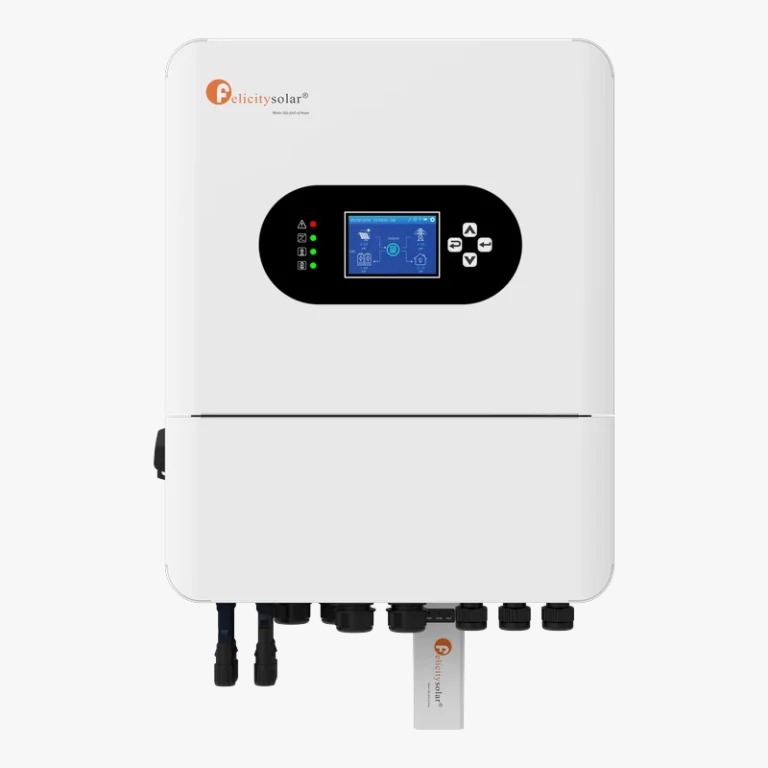
You wake up on Saturday morning. Coffee in hand. You check your solar app. The battery is at twelve percent. It should be at eighty percent. Something ran all night. You scroll through the energy history. A space heater. A garage freezer. A forgotten outdoor light. None of these were supposed to run on battery power. Your inverter has a setting called “battery reserve” or “minimum state of charge.” You set it to twenty percent. That means the inverter should stop powering loads from the battery when the battery drops below twenty percent. But someone changed the setting. Or the installer never set it correctly. Or a firmware update reset it to the default of zero percent. A hybrid solar inverter without proper notification settings will drain your battery to empty while you sleep. You wake up with no stored energy for the next grid outage. The solution is not a better battery. The solution is an inverter that alerts you when the battery reserve setting changes or when the battery drops below your configured threshold. Ask your app to notify you. Then test it. If no notification arrives, your inverter is silent about the problem. That silence costs you backup power when you need it most.
The Time Zone Glitch That Ruins Time-Of-Use Savings
Your utility has peak rates from 4 p.m. to 9 p.m. You programmed your inverter to run the house from batteries during those hours. Perfect. Then daylight saving time ends. The clocks fall back. Your inverter does not. It still thinks peak rates start at 4 p.m. old time. That is 3 p.m. new time. Your batteries start discharging an hour early. They run out of power at 8 p.m. instead of 9 p.m. You buy expensive grid power for the last hour of peak rates. This happens twice a year to thousands of solar homeowners. Their hybrid solar inverter loses track of time. The fix is simple. Automatic time synchronization with an internet time server. But many budget inverters lack this feature. You must manually update the time zone and daylight saving setting twice per year. Most people forget. Ask your inverter supplier how time zone changes are handled. If they say “manual update,” ask yourself whether you will remember to do it in November and March. The honest answer for most people is no. Choose an inverter that handles time automatically. Your utility bill depends on it.
The Grid Voltage Window That Rejects Your Solar
Your inverter constantly monitors grid voltage. If the voltage goes too high or too low, the inverter disconnects. This is a safety feature. But some utilities operate at voltage extremes. Rural areas with long distribution lines often see voltage swings. Your inverter disconnects multiple times per day. Your solar production stops. Your batteries stop charging. Your hybrid solar inverter has programmable voltage windows. Wider windows allow more uptime. Narrower windows provide more safety. The default settings from the factory are often too narrow for rural grids. Your installer should adjust the voltage window based on your actual grid conditions. Ask to see the voltage log from your first week of operation. If you see frequent disconnections, the window is too narrow. Ask your installer to widen it within legal limits. Your local utility can provide the allowed range. Stay within that range. But do not accept the factory defaults without checking. Defaults are guesses. Your grid is not a guess. It is a measurable reality. Measure it. Adjust accordingly.
The Frequency Shift That Confuses Your Generator
You have a backup generator. Great. Your hybrid inverter can accept generator power. Also great. But generators do not produce perfect electricity. The frequency wanders. Fifty-nine point eight hertz. Sixty point two hertz. A hybrid solar inverter expects sixty hertz. When the generator frequency drifts, the inverter may refuse the connection. Or it may connect and disconnect repeatedly. Your lights flicker. Your appliances complain. You stand in the garage yelling at both machines. The solution is an inverter with a wide frequency acceptance range. Fifty-nine to sixty-one hertz is standard. Fifty-five to sixty-five hertz is generous. Ask your inverter supplier about generator compatibility before you buy. Better yet, ask them to test their inverter with your specific generator model. If they refuse, assume it will not work reliably. Your generator is expensive. Your inverter is expensive. They should work together. Do not accept a system where you must choose between solar power and generator power. A true hybrid uses both seamlessly. Keep asking until you find one that does.
The CT Placement Error That Reads Your Grid Wrong
Your inverter measures grid import and export using current transformers. Little clamps that go around your utility wires. If those CTs are installed backward or on the wrong wires, the inverter sees the wrong data. It thinks you are exporting when you are importing. It charges your batteries from the grid unnecessarily. Or it discharges your batteries to the grid when you meant to save them. The hybrid solar inverter depends entirely on correct CT placement. One misplaced clamp ruins every automated function. Time-of-use shifting fails. Zero export fails. Battery charging from solar only fails. Ask your installer to show you the CT readings during commissioning. The grid import reading should be positive when your home draws power. Negative when you export. If the signs are reversed, the CT orientation is wrong. Fix it before the installer leaves. CT errors are the most common installation mistake. They are also the easiest to fix on the spot. Do not accept a signed-off system until you have seen correct readings with your own eyes.
The One Test That Confirms Your Inverter Understands You
Take a hair dryer. Plug it into an outlet on the backup loads panel. Turn it on. Watch the inverter app. The battery discharge rate should increase immediately. The grid import should stay the same or decrease. This test confirms that your hybrid solar inverter knows which loads are backed up and which are not. If turning on the hair dryer increases grid import instead of battery discharge, your CTs are wrong or your loads panel is miswired. Run this test before you sign any final paperwork. It takes thirty seconds. It reveals problems that would otherwise frustrate you for years. A good installer will welcome this test. A bad installer will make excuses. Your inverter works for you. Make sure it proves that understanding before you hand over the final payment. A hair dryer is a cheap diagnostic tool. Use it. Your future self will appreciate every correctly configured watt.