The capability to convert text to video has completely transformed the landscape of digital production, allowing creators to materialize complex visual sequences directly from simple written descriptions. Traditional filmmaking pipelines—which require extensive filming locations, high-end camera rigs, and prolonged post-production cycles—are being rapidly augmented or replaced by these sophisticated generative engines. By parsing natural language, these software suites construct highly detailed 3D spaces, apply realistic physics, and establish complex lighting schemas without the need for manual rendering.
As digital marketing agencies, social media managers, and independent creators face a continuous demand for fresh visual media, selecting the correct platform to convert text to video becomes a critical infrastructure choice. The modern marketplace offers a wide variety of tools, yet each generative framework features distinct rendering algorithms, prompt-processing capacities, and motion capabilities. This listicle provides a thoroughly researched, neutral evaluation of the five best generative platforms currently available, highlighting how each system approaches content synthesis to help teams maximize their creative output.
1. Pollo AI
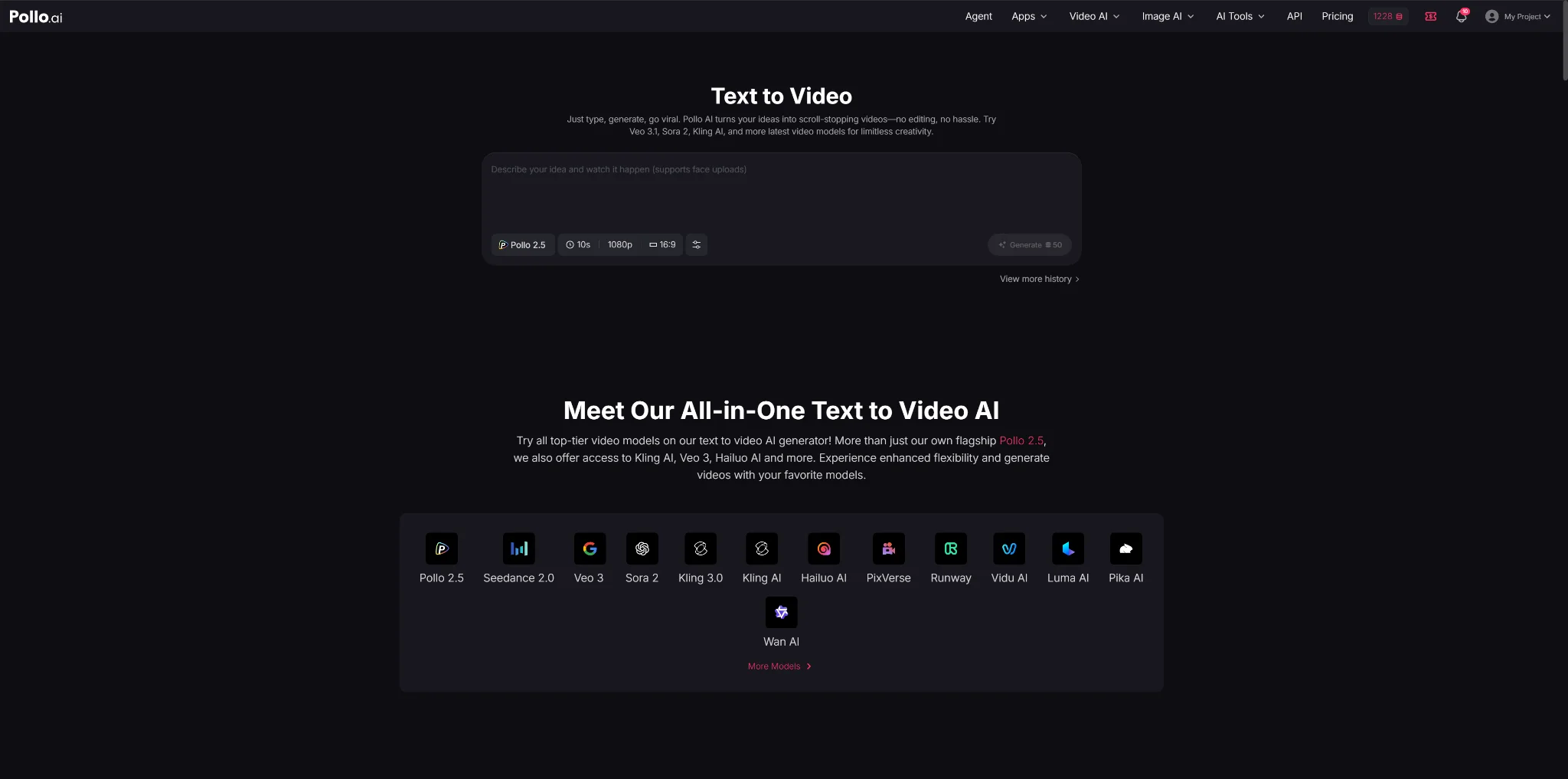
Pollo AI is positioned as an all-in-one multimodal video creation ecosystem designed to convert text to video through a deeply integrated multi-model architecture. Instead of relying on a single generation engine, it unifies multiple leading AI video models such as Pollo 2.5, Seedance 2.0, Veo 3, Kling 3.0, Runway, and others into a single interface, allowing users to dynamically choose the best model for different creative outputs. The platform supports a full spectrum of generation modes including text to video, image to video, reference to video, and video to video transformation. Beyond core generation, it also extends into specialized AI applications such as UGC video ads, product video creation, clone video ads, testimonial videos, cinematic trailers, anime-style generation, and social media short-form content production. In addition, Pollo AI includes advanced tools like AI video upscaling, lip-sync generation, animation effects, background removal, and AI video editing via prompt control, forming a complete production pipeline from ideation to final export within one system.
Why It’s Worth Using
Pollo AI’s core advantage lies in its ability to serve as a unified production infrastructure for virtually every type of AI video workflow, making it far more than a simple text to video generator. It is particularly valuable for marketers, agencies, creators, and e-commerce brands that need to produce high-volume, conversion-driven video content across multiple platforms. With dedicated applications for UGC ads, Facebook ad creatives, product showcases, celebrity-style videos, faceless content, YouTube outro videos and even a dedicated YouTube outro maker workflow, as well as viral social media clips, it significantly expands the practical usage scenarios beyond traditional video generation tools. The platform is also optimized for business efficiency, enabling up to 60–80% reductions in production cost and dramatically accelerating bulk video creation workflows. Its ability to combine multiple generation models with plug-and-play “apps” makes it highly adaptable for different industries, from filmmaking and music videos to explainer content and narrative storytelling. For users who require both creative diversity and enterprise-level scalability, Pollo AI delivers one of the most complete and commercially practical ecosystems in the text-to-video space.
2. Runway (Gen-3 Alpha)
Runway Gen-3 Alpha is a high-end generative video model designed to convert text to video with a strong emphasis on cinematic realism and temporal consistency. It is widely adopted by filmmakers, visual effects artists, and professional studios due to its ability to maintain physical accuracy across frames. The system supports advanced prompt interpretation, including detailed camera specifications, lighting conditions, and environmental rendering. Its architecture is optimized for stability, reducing visual artifacts such as texture flickering or object deformation during motion sequences. Additionally, Runway supports video-to-video transformation, allowing users to restyle existing footage into entirely new visual interpretations.
Why It’s Worth Using
Runway is particularly valuable for creators who prioritize cinematic quality and professional-grade visual storytelling when they convert text to video. It excels in scenarios requiring atmospheric precision, such as film pre-visualization, advertising production, and high-end brand storytelling. The platform responds effectively to technical prompts involving lens types, depth-of-field adjustments, and lighting styles like chiaroscuro. Its advanced camera control system enables complex motion design, including crane shots and dynamic perspective shifts. For professionals who treat AI as a precision filmmaking tool rather than a rapid content generator, Runway provides one of the most reliable and visually sophisticated environments available.
3. Kling AI
Kling AI is engineered specifically to convert text to video with extended temporal continuity, making it one of the strongest solutions for long-form generation. Unlike many competitors limited to short clips, Kling supports longer sequences that can maintain coherence across extended durations. Its architecture focuses on spatial memory and object persistence, allowing characters and environments to remain stable across time. The system is capable of interpreting complex narrative prompts, including multi-scene actions, environmental transitions, and evolving story arcs within a single generation process.
Why It’s Worth Using
Kling AI is especially effective for storytelling-focused creators who need to convert text to video in a structured narrative format. It is well-suited for educational content, serialized storytelling, and documentary-style production where continuity is critical. The platform excels at maintaining character identity consistency, preventing visual drift across scenes. This makes it highly useful for script-to-video pipelines where multiple actions occur sequentially. For creators who require longer, uninterrupted storytelling output rather than short generative clips, Kling AI provides a strong foundation for building coherent visual narratives.
4. Pika (Pika 2.0)
Pika 2.0 is a creatively oriented platform designed to convert text to video with a strong emphasis on stylistic expression and animation flexibility. It supports a wide range of visual styles, from stylized 2D animation to imaginative surreal environments. The system includes object-level motion control, allowing users to define precise movement paths for individual elements within a scene. It also integrates enhanced frame stability and higher resolution output compared to earlier versions. Additionally, Pika features automated audio generation that synchronizes sound effects with visual motion, creating a more immersive production experience.
Why It’s Worth Using
Pika is ideal for creators who prioritize creative experimentation over strict realism when they convert text to video. It is widely used by social media creators, animators, and short-form content producers who need visually distinctive outputs. Its intuitive motion tools allow rapid iteration of ideas without technical complexity. The platform is particularly strong for producing viral-style content, animated loops, and stylized storytelling assets. Pika also supports targeted editing through inpainting tools, enabling users to modify specific parts of a video without re-rendering the entire scene. This makes it highly efficient for fast-paced creative workflows.
5. HeyGen
HeyGen is a specialized enterprise-focused platform designed to convert text to video using AI-powered digital avatars. Instead of generating cinematic environments, it focuses on human presentation systems with realistic facial animation, lip-syncing, and gesture modeling. Users input scripts, and the system produces avatar-led presentations that simulate professional on-camera delivery. It includes a large library of avatars, voice options, and multilingual speech synthesis capabilities. A key feature is custom avatar creation, allowing organizations to generate personalized digital representatives for scalable communication.
Why It’s Worth Using
HeyGen is particularly valuable for corporate environments that need to convert text to video for training, marketing, and internal communication. It significantly reduces the cost and time associated with traditional video production involving human presenters. The platform excels in localization, enabling rapid translation of video content into multiple languages while preserving voice consistency. This makes it ideal for global organizations that require scalable communication across regions. It is especially useful for onboarding materials, sales presentations, and executive announcements, where clarity and consistency matter more than cinematic complexity.
Conclusion
The ability to convert text to video has evolved from a niche AI capability into a core infrastructure layer for modern content production. Each platform in this ecosystem serves a distinct creative function: Pollo AI focuses on workflow consolidation, Runway emphasizes cinematic precision, Kling AI enables narrative depth, Pika prioritizes creative flexibility, and HeyGen specializes in corporate communication. Together, they represent a complete spectrum of use cases spanning entertainment, marketing, education, and enterprise communication. As generative systems continue to advance, the distinction between text input and professional-grade video output will become increasingly seamless, fundamentally redefining how digital content is produced at scale.