In an era dominated by clicks, swipes, and digital forms, the simple act of a phone call might seem like a relic of a bygone era. Yet, when it comes to gathering meaningful insights, the telephone remains a powerful and surprisingly relevant tool. With 98% of Americans owning a cellphone, the potential reach of a well-executed phone survey is nearly universal. But what exactly is a survey call, and how does it fit into the modern data collection landscape?
This guide will demystify the world of telephone-based data collection. We will explore everything from the fundamental definition and core technologies to advanced strategies for survey design, sampling, and execution. You will learn why this method continues to be a cornerstone for industries ranging from market research to healthcare, and how to harness its unique ability to blend technology with a crucial human touch to achieve your research goals.
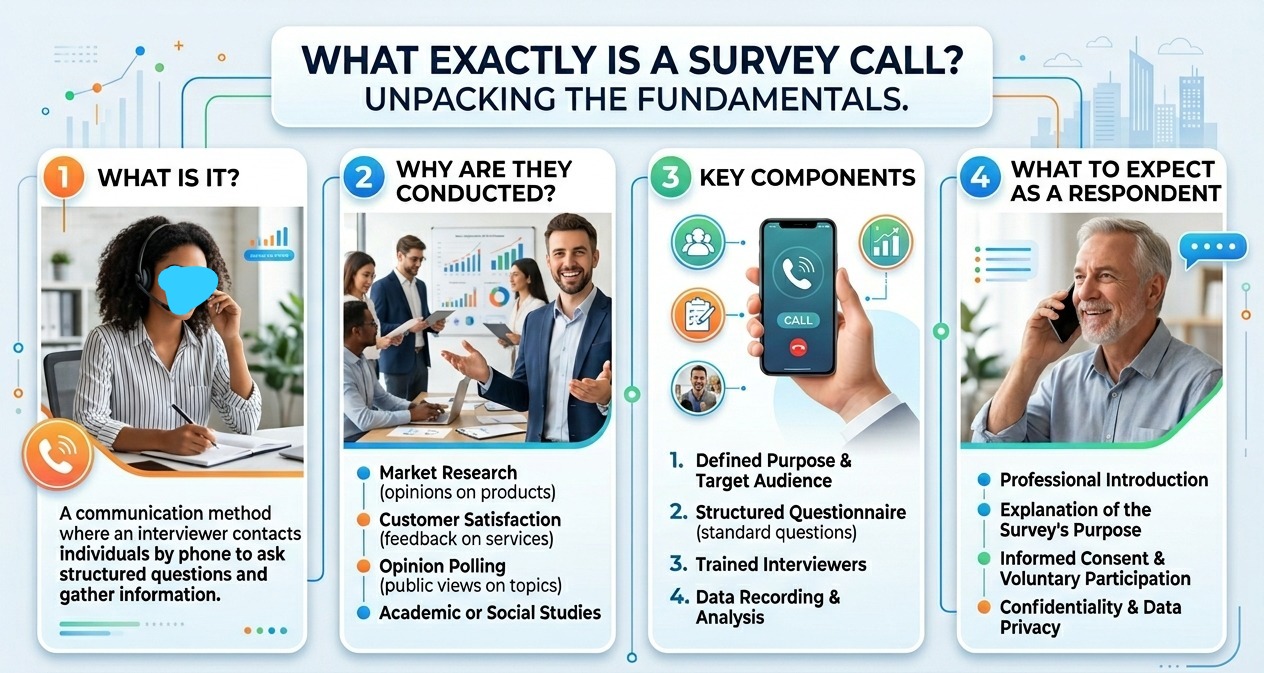
What Exactly is a Survey Call? Unpacking the Fundamentals
A survey call, at its core, is a structured data collection method where a trained interviewer contacts a respondent via telephone to administer a questionnaire. This telephone interview is a systematic process designed to gather specific quantitative or qualitative data from a predefined sample of a population. Unlike a casual conversation, every aspect from the introduction to the wording of the survey questions is carefully planned to ensure consistency and minimize bias.
While the objective is similar to other survey methods, the execution differs significantly:
- Online Survey:Relies on respondents to self-navigate a digital form, often sent via a survey link in an email. This method offers scalability but lacks the interactive element to clarify confusion or probe for deeper answers. In fact, with nearly six out of ten surveys taken via mobile, survey design must be mobile-first, but even then, it can’t replicate a human conversation.
- Face-to-Face Interviews:Provide rich, in-depth data and allow for observation of non-verbal cues. However, they are geographically limited, expensive, and logistically complex.
- TELEPHONE SURVEYS:Strike a unique balance. They offer a broader geographic reach than in-person interviews while retaining the “personal touch” that an online survey This is crucial in a world where disengagement can have significant economic consequences, costing the global economy $438 billion in lost productivity in recent years.
The success of a phone survey hinges on a well-crafted survey instrument, which is the complete package of all materials used in the research, including the questionnaire, call script, and interviewer instructions. The engine driving modern telephone surveys, however, is technology. Two primary systems dominate the field:
- Computer-Assisted Telephone Interviewing (CATI):This is the industry standard. Interviewers read questions from a computer screen and input responses directly into the system. The software automatically handles question logic, branching, and randomization, ensuring high data quality and efficiency.
- Interactive Voice Response (IVR):This is an automated system where respondents interact with pre-recorded questions using their phone’s keypad or voice commands. IVR is ideal for short, simple surveys, such as a quick Customer Satisfaction poll after a service call.
Beyond the Buzz: Why Telephone Surveys Still Command Respect
In our hyper-digital world, it’s easy to assume the phone survey is obsolete. However, its enduring relevance comes from a unique set of advantages that purely digital methods cannot replicate. It’s not about replacing digital tools, but about understanding where the telephone provides superior value.
The primary advantage is the personal touch. A skilled interviewer can build rapport, establish trust, and guide a respondent through complex topics. This human element is invaluable for:
- Clarifying Ambiguity:If a respondent is unsure about a survey question, the interviewer can provide immediate, standardized clarification, preventing misinterpretation and improving data quality.
- Probing for Deeper Insights:Unlike a static online form, a telephone interview allows for follow-up questions and probing on open-ended responses, capturing rich qualitative data and granular complaints data that would otherwise be lost.
- Reaching Hard-to-Reach Populations:Certain demographics, such as older adults or residents in rural areas with limited internet access, are more accessible via telephone. This makes phone-based surveys essential for inclusive and representative Market Research.
- Improving Response Rates:A polite, professional interviewer can engage a hesitant respondent and use proven refusal conversion techniques to encourage participation, often leading to higher completion rates than an easily ignored email.
These benefits make TELEPHONE SURVEYS a vital tool across numerous sectors. Management/consulting firms use them for project evaluation data, the healthcare industry for patient experience feedback, and financial services providers for market monitoring and understanding customer needs. A well-executed customer satisfaction survey over the phone can provide a far more nuanced understanding of the customer experience (CX) than a simple star rating.
Crafting a Winning Survey: Design and Questionnaire Principles
The effectiveness of a survey call lives and dies by its survey design. A questionnaire that works well on a screen can be confusing and cumbersome when read aloud. Therefore, crafting a winning survey script requires a specific set of best practices.
- Keep it Concise and Clear:Attention spans are shorter over the phone. Survey questions must be direct, unambiguous, and easy to understand on the first hearing. Avoid jargon, double-barreled questions, and complex sentence structures.
- Structure the Flow Logically:The survey script should have a natural, conversational flow. Start with a clear introduction explaining the survey’s purpose and assuring confidentiality. Group related questions together and move from broad topics to more specific ones.
- Optimize for Oral Delivery:When designing questions with scales (e.g., a Likert scale), keep the options limited and clear. Instead of “On a scale of 1 to 10,” which is hard to track mentally, use simpler scales like “Would you say you are very satisfied, somewhat satisfied, neither satisfied nor dissatisfied, somewhat dissatisfied, or very dissatisfied?” Always repeat the scale for clarity.
- Balance Depth and Length:A lengthy survey will lead to respondent fatigue and higher drop-off rates. Aim for a reasonable completion time (typically under 15-20 minutes). Prioritize your CX goals and focus the survey content on the most critical information you need.
- Plan for Open-Ended Responses:For qualitative insights, include open-ended questions. The interviewer must be trained to record responses verbatim without summarizing or interpreting, ensuring the authenticity of the customer feedback.
Effective questionnaire design is the foundation upon which the entire data collection process is built. A well-designed survey instrument makes the interviewer’s job easier and provides a better user experience for the respondent, ultimately leading to higher-quality research data.
Reaching Your Audience: Strategic Sampling for Phone Surveys
Who you call is just as important as what you ask. Sampling is the process of selecting a representative subset of a population to participate in your survey. For phone-based surveys, several methods are used to build a robust sample.
- Random Digit Dialing (RDD):This is a classic method where phone numbers are randomly generated. RDD is excellent for reaching a broad, general population, including those with unlisted numbers. It helps ensure that every household or individual with a phone has a chance of being selected.
- Telephone Directories:Using listed numbers from public directories is another option, but it has significant limitations. It excludes individuals with unlisted numbers or those who only use mobile phones, potentially skewing the sample.
- Customer Lists & Virtual Phone Banking:For research focused on a specific customer base, such as a customer satisfaction survey, companies can use their own lists of phone numbers. Modern virtual phone banking software can help manage these lists efficiently, dialing and connecting agents only when a person answers.
- Mitofsky–Waksal Method:This is a more advanced, two-stage sampling technique that improves the efficiency of RDD. It involves randomly selecting blocks of 100 consecutive telephone numbers and screening them. If a block contains residential numbers, more numbers are called from that block. This method is more cost-effective as it concentrates call attempts in blocks that are more likely to yield results.
Effective sample management is critical to avoid quota concerns, where certain demographic groups are over- or under-represented. The research team must monitor survey progress in real time to ensure the final sample aligns with the target population’s characteristics.
The Interviewer’s Art: Executing Flawless Phone Surveys
Technology provides the framework, but the interviewer delivers the experience. The quality of a telephone interview depends heavily on the skill of the research team and the meticulousness of the execution process.
The journey to flawless execution begins with training interviewers. This isn’t just about reading a script; it’s about developing a specific skill set. Comprehensive training courses and evaluation workshops should cover:
- Survey Protocols:Understanding the research objectives, confidentiality rules, and every detail of the survey instrument.
- Communication and Rapport:Learning to speak clearly, maintain a professional and empathetic tone, and build a connection with the respondent.
- Neutrality:Training to ask questions exactly as written and avoid introducing bias through tone of voice or rephrasing.
- Refusal Conversion:Equipping interviewers with polite, effective techniques to handle initial refusals and encourage participation without being aggressive.
The backbone of modern execution is computer-assisted telephone interviewing (CATI) software. This survey deployment software streamlines the process by managing call attempts, logging call outcomes in call logs, and automatically routing questions. This ensures that every interviewer follows the same path, which is critical for data consistency.
For simpler, high-volume surveys, interactive voice response (IVR) can be a cost-effective alternative. IVR surveys are automated and can handle thousands of calls simultaneously, making them perfect for post-interaction feedback or political polling.
Finally, managing the outreach process involves strategic call attempts and proper use of caller identification. Displaying a recognizable name or number can increase the chances of the call being answered.
Data Integrity: Quality Assurance and Analysis
Collecting data is only half the battle; ensuring its accuracy and analyzing it correctly is paramount. Rigorous data quality checks are a non-negotiable component of any professional research project.
A multi-layered quality monitoring process is essential. This includes:
- Audio Audits:Supervisors or dedicated quality assurance staff listen to call recordings to evaluate interviewer performance, adherence to the call scripts, and overall data accuracy.
- Remote Monitoring Research:Many CATI systems allow for silent, real-time monitoring of live interviews, enabling supervisors to provide immediate feedback or intervene if necessary.
- Data Validation Tests:Once data is collected, data analysts run checks for logical inconsistencies, out-of-range values, or unusual response patterns. For example, if a respondent says they are 25 but also retired, the data needs verification.
Once the research data is cleaned and validated, data analysis can begin. This can range from simple frequency counts and cross-tabulations to more complex statistical techniques like regression analysis to identify relationships between variables. The goal is to transform raw numbers into actionable insights.
An important consideration throughout this process is response bias, which occurs when respondents answer questions in a systematically inaccurate way. For example, social desirability bias might cause people to over-report positive behaviors. Skilled interviewers and carefully worded questions can help mitigate this risk. Protecting personal information is also a top priority, and all survey protocols must adhere to privacy regulations.
Navigating the Challenges: Limitations and Considerations
While powerful, TELEPHONE SURVEYS are not without their challenges. Acknowledging these limitations is key to using the method effectively.
The most significant hurdle is the declining response rate. In an age of spam calls and caller ID, many people are hesitant to answer calls from unknown numbers. Low Response Rates can introduce non-response bias, where the people who do participate are systematically different from those who don’t, potentially skewing the results. This is a critical challenge that requires strategic refusal conversion and transparent communication.
Other challenges include:
- Potential for Bias:Beyond non-response bias, interviewer bias can occur if an interviewer’s tone or demeanor influences answers.
- Comparison with Digital Surveys:An online survey is often faster and cheaper for large, simple projects. The process of gathering email addresses and sending a survey link is less labor-intensive than managing a call center. However, the digital response may suffer from lower engagement and a lack of depth.
- Operational Costs:Running a professional call center with a trained research team, CATI software, and telephone charges can be more expensive than deploying a digital survey.
Organizations must weigh these challenges against the unique benefits. For complex research, sensitive topics, or populations that are difficult to reach online, the investment in a high-quality phone survey often provides a superior return.
Conclusion: The Telephone Survey’s Enduring Value
In a world saturated with digital communication, the telephone survey stands out as a method that uniquely combines broad reach with a personal, human connection. It is not an outdated technique but a strategic choice for researchers who prioritize high-quality, nuanced data. From rigorous survey design and advanced sampling to the skilled execution by a well-trained research team, a successful phone survey is a masterclass in methodical data collection.
While challenges like response rate persist, the telephone’s ability to clarify complex questions, probe for rich qualitative insights, and include demographics often missed by digital-only approaches ensures its continued relevance. By understanding its strengths and navigating its limitations, organizations can leverage the power of the survey call to gather the critical data needed to drive informed decisions, improve the customer experience, and achieve their most important CX goals