In the current digital era, the reliability of market research is under siege. As businesses scramble to capture insights, the market has become saturated with “noise”—from sophisticated survey bots to automated survey farms that threaten the integrity of every data set. For decision-makers, relying on a single-channel approach is no longer just a tactical oversight; it is a fundamental risk to data validity. To achieve a truly accurate “true north,” organizations must move toward hybrid survey methods.
📊 What Are Hybrid Survey Methods?
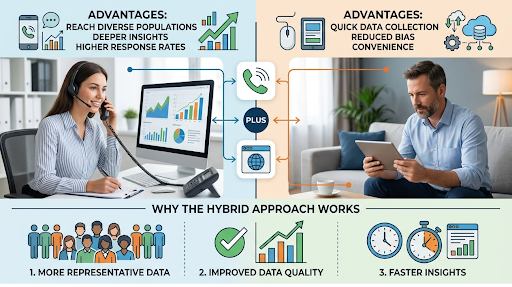
The Hybrid Survey Method combines the speed and reach of online surveys with the depth and rigor of phone interviews to produce highly accurate, unified data.
Hybrid survey methods represent the strategic integration of disparate data collection channels, specifically blending online surveys with phone surveys, to achieve a comprehensive view of a target audience. In this framework, the survey platform acts as a unified hub where multiple inputs are synthesized.
Rather than treating these as competing silos, hybrid research leverages the speed of the web with the rigor of human-led interviews. By utilizing computer-assisted telephone interviewing (CATI) alongside a modern online questionnaire, researchers can capture both high-volume quantitative data and high-depth qualitative sentiment. This approach is essential for mitigating the risks associated with nonprobability surveys, ensuring that the survey objectives are met through a balanced, multi-modal design.
📞 The Strength of Phone Surveys in Data Collection
While digital tools have surged, Telephone surveys remain the gold standard for high-stakes research. The primary advantage of phone-based surveys is the element of human interaction, which acts as a powerful corrective to the limitations of self-completion surveys.
Professional interviewers can clarify complex question wording in real-time, ensuring that respondents understand the intent behind attitudinal items. Phone interviews help create a good connection with people, which makes them more likely to respond than they would to emails or digital messages. Using phone methods lets us get lots of detailed and trustworthy feedback right away.
💻 The Speed and Reach of Online Surveys
In contrast, online surveys are the backbone of modern efficiency. Nowadays, surveys need to be designed for mobile devices to reach people who only use wireless gadgets.
These surveys excel in their ability to reach geographically dispersed segments rapidly. Online tools help gather lots of data cheaply, either through email invites or social media links. Researchers need to make sure the survey looks good on all screens and works well on any device to get the best results. When executed with precision, online instruments provide the breadth necessary for broad market research initiatives, serving as a rapid-fire tool for assessing consumer behaviors.
⚖️ Why Combining Both Methods Works Best
The synergy created by hybridizing these survey methods addresses the core challenge of the “mode effect,” a phenomenon identified by the Pew Research Center, where the medium of the survey subtly alters how a respondent answers.
By using both, researchers can calibrate their findings to account for these mode differences. For instance, a phone respondent might be more candid about sensitive subjects, while a web respondent might be more comfortable with long-form, logic-heavy questions. Combining these approaches mitigates measurement bias and provides a more robust, representative sample. The best way to handle market research is by combining fast digital methods with detailed traditional methods.
🏢 Real-World Applications of Hybrid Surveys
Hybrid strategies are indispensable for high-accuracy research. In home improvement, companies use web surveys to get feedback on their products and follow up with phone calls to check on complicated customer complaints.
Pollsters call random phone numbers to get a good mix of people, and then add online surveys to see how often people check the news. This approach is important for social programs and government groups that need reliable data. By ensuring that the sampling frame includes both digital natives and older or less-connected populations, hybrid models provide a holistic view of the target audience that single-channel surveys frequently miss.
🔍 Enhancing Data Accuracy with Hybrid Strategies
In the wake of rising bad actors and bogus respondents, data quality has become the primary KPI for any survey company. Hybrid strategies serve as a “fraud firewall.” Researchers can get rid of survey bots and fake entries by having people check some of the online participants.
Using AI to analyze speech, along with regular data cleaning, helps find mistakes in survey answers. This level of quality control ensures that the final dataset is pristine, allowing business leaders to make business decisions based on authentic consumer sentiment rather than automated noise. When you integrate verification with a stratified sample, you move from simply collecting responses to building an actionable, high-integrity intelligence asset.
🚀 Conclusion: A Smarter Way to Collect Data
Switching to hybrid survey methods is an important step for the survey research industry. In a world where AI can act like humans, phone interviews supported by reliable survey calling services are essential to keep your data accurate.
By combining the speed of online tools with the rigor of phone-based engagement, you solve for both efficiency and accuracy. As you design your next campaign, remember that the goal is not merely to collect more responses, but to collect better responses. Using a hybrid model will keep your data safe, help you respond faster, and give you the clear insight you need to succeed in a complex world.
Focus on a multi-modal, quality-first approach to ensure your research remains resilient, representative, and ready for the challenges of tomorrow.