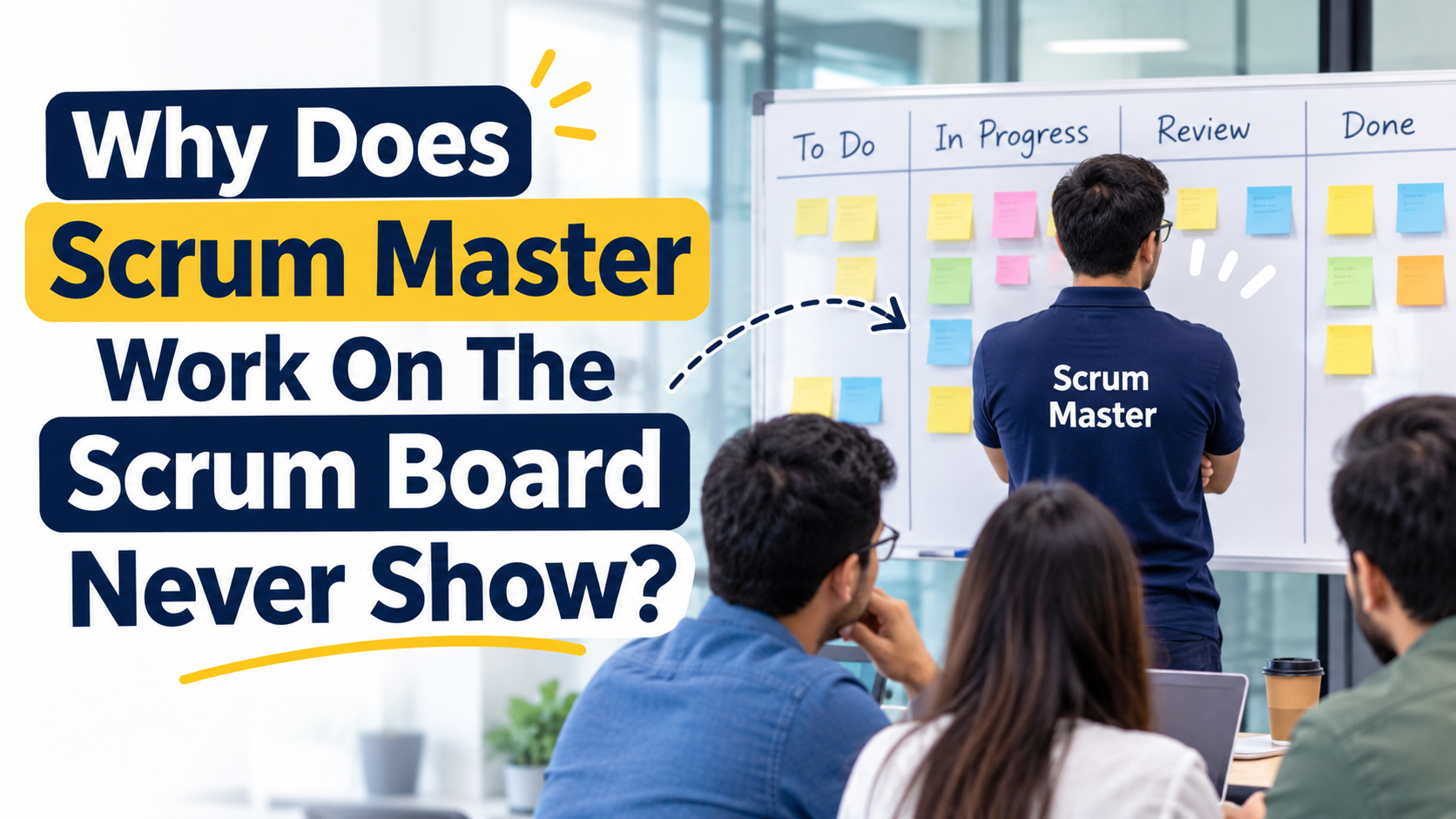
Look at a team’s Scrum board during a Sprint, and you will see cards and stickies move from the “To Do” column to “Done.” Something missing? The Scrum Master. Often, there is no visible indication of the work the Scrum Master does to keep the team aligned and engaged with the Sprint goal.
Whether you are exploring CSM Certification Training or already working with a Scrum team, let’s take a look at the other side of the board to understand the work the Scrum Master does outside of the board. We will cover a realistic sprint example, what the Scrum board is meant to capture, why work card updates do not paint a true picture of a Scrum Master’s work, and more.
What a Scrum Board Is Built to Show
Officially, the Scrum board captures the “Sprint Backlog.” It is a visual representation of the items a team has committed to complete during a Sprint, also the plan the team has to deliver those items. Not all teams implement an official Scrum board during a Sprint, but it is recommended and widely practiced to do so, whether it is in a physical location or in a digital tool like Jira. Progress can be quickly assessed, and blocks can be easily adapted to meet the ever changing requirements of customers and stakeholders.
The key to understanding Scrum is focusing on ownership. The Sprint Backlog is the Developers’ property. Developers break stories down into tasks, and those tasks move along the board. The board is a tool that answers, “Where is the work?”
The Scrum Master owns a different tool. It is a sense of “how is the work.” This is determined by conditioning, conversations and habits, and absolutely none of that can be captured on a sticky note. In the absence of the Scrum Master owning the work, it often means the team has not taken ownership of their plan.
The Responsibilities That Happen Off the Board
Removing Impediments Before They Stall the Sprint
An obstacle is usually a missing permission, a stakeholder, or a dependency. It is slowing the team down but they can’t do anything about it on their own. A good Scrum Master identifies these obstacles and helps remove them, not always through their own effort, and sometimes only through conditioning the team to do the same in the future.
Facilitating Scrum Events That Actually Help
A Scrum Master serves the team and helps it continually work together to move the product backlog items to a shippable state. This is accomplished by facilitating the Scrum events, Sprint planning, reviews and retrospectives.
Most of the facilitation is preparation and control. It is knowing that a Daily Scrum has changed into a status report for a manager and steering it into a planning conversation among Developers. It is understanding people have stopped speaking openly in a particular retrospective format and changing it. None of it shows up in a to-do list, and without it, meetings can turn into a waste of an hour.
Coaching People and Building Better Habits
The role is also largely coaching. Scrum Masters help Developers become self-managing and help the Product Owner keep the Product Backlog clear and in order. The Scrum Master helps the larger organization understand how Scrum works in practice.
The coaching doesn’t look like teaching. Often, it’s letting the team spot a problem in a retrospective rather than telling them. Or, it’s asking a simple question during a one-on-one that allows them to see a problem for themselves.
A Sprint Example: The Board vs. What Happened
Taking the example of a team building a payments feature, on day three of a two week sprint, a story gets stuck in “In Progress” while the team waits on API credentials from a vendor.
The card remains in the same position for two days on the board and then is moved to ‘Done’ at last. Off the board, the Scrum Master removed the blocker right after the daily scrum and found that the request was sitting in a procurement queue. The Scrum Master worked with the engineering manager to prioritize the request. Also, they noticed two developers working on separate workarounds and suggested they pair on their work. At the retrospective, the team committed to working with the third party to gain access to their tools during backlog refinement, rather than waiting to do it during the sprint.
In this case, the board captured one card, one delay and one block. What really occurred was reducing wasteful effort, several blockers, and delivering a process change that benefits future sprints.
Why Card Updates Don’t Measure a Scrum Master’s Value
Judging a Scrum Master by board activity is as useful as judging a football coach by how often they touch the ball. The true impact of both is in how their respective teams perform. Better things to look for include:
- Blockers raised early and resolved quickly
- Scrum Events finished within their time boxes and result in a clear outcome
- Developers managing their own work and being able to self-adjust
- Retrospective actions result in improvement for the next sprint
Reaching this level takes a combination of many skills, including facilitation, coaching and Agile practices. For Scrum Masters operating in a scaled Agile environment, the SSM Certification Course with Simpliaxis dives into how the role integrates with SAFe.
Conclusion
Scrum boards don’t capture all the work that goes into agile development, much of which is represented by cards, facilitation, coaching, and the removal of impediments. That’s why so much of a Scrum Master’s work is invisible.
Continuous improvement takes many forms. A team that engages in continuous improvement is a team that plans better and unblocks itself. So, instead of wondering what the Scrum Master does all day, look at the cards and the team. If the cards are continuously in motion, there is a reason.