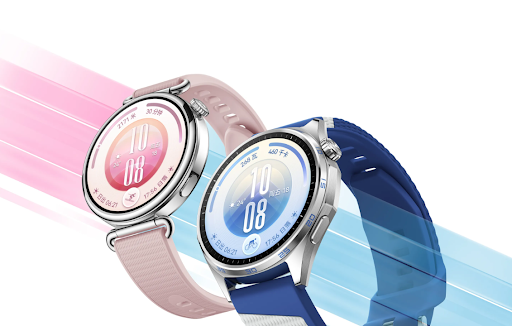
Every smartwatch review eventually arrives at the same question, and every active person already knows why: how long does the battery last? Features mean little when the device dies mid-workout, and health tracking means less when the watch spends every night on a charger instead of on the wrist. The Watch GT7 tackles this fundamental problem head-on, delivering up to 21 days of typical battery life — a figure that changes not just how often the watch gets charged, but how it gets used.
That endurance is worth examining properly, because it is the foundation on which the entire experience rests: the sports modes, the health monitoring, the training intelligence. All of it depends on the watch simply being there, powered on, day after day.
What 21 Days Actually Means in Practice
Abstract numbers become concrete quickly in real life. Twenty-one days covers a two-week adventure holiday with GPS-tracked activities every day and a week to spare. It covers three weeks of normal training — runs, rides, gym sessions, sleep every night — without a thought for the charger. It means a business trip, a ski week, or a trail racing season with one less device to manage.
Compare that to the rhythm of conventional smartwatches, where charging is a nightly or every-few-days ritual. Those charging windows are precisely when health data goes missing: the sleep that never gets recorded, the overnight heart rate variability that feeds recovery metrics, the resting heart rate trends that flag oncoming fatigue or illness. Gaps in data are gaps in understanding.
A watch that stays on the wrist around the clock produces something fundamentally more valuable — a continuous, unbroken record of the body’s behaviour. Training analysis, readiness scoring, sleep architecture, stress patterns: every insight sharpens when the data behind it is complete.
The Technology Behind the Stamina
Long battery life in a full-featured smartwatch does not happen by accident. It is the product of deliberate engineering choices working together: a high-capacity battery fitted into the case architecture, power-efficient chipset design, and software that manages energy intelligently across every subsystem.
The AMOLED display illustrates the approach. Bright and vivid when in use — fully readable in direct sunlight — it draws minimal power at rest, showing information only when needed. Sensor suites sample intelligently rather than wastefully, capturing continuous health data without the brute-force polling that drains lesser devices. GPS tracking, historically the hungriest feature on any sports watch, is engineered for efficiency across multi-hour activities.
The result is a watch that does not ask its owner to make trade-offs. There is no need to disable continuous heart rate monitoring to survive the week, no need to choose between the morning run’s GPS track and the evening’s sleep data. The features are meant to be used, and the battery is built to let them be used.
Endurance Meets Its Natural Partner: Outdoor Sport
Battery life matters everywhere, but it matters most outdoors, where charging opportunities disappear and activities run long. This is where the watch’s sports credentials align perfectly with its stamina.
The all-new skiing mode captures full days on the mountain — descents, vertical, speed, heart rate — from first lift to last, with power to spare. The all-new cycling mode handles century rides and multi-day tours without range anxiety. More than 110 workout modes cover everything in between, each one backed by the confidence that the watch will outlast the athlete.
For multi-day adventures — bikepacking weekends, hiking traverses, ski touring trips — the arithmetic is simple. A device that measures its battery life in weeks does not feature in the packing calculus at all. It goes on the wrist at the start of the trip and comes off at the end, having recorded everything in between.
Charged Less, Understood More
The deeper value of endurance reveals itself in the health features. The Physical Readiness Score — the watch’s daily measure of how prepared the body is for training — depends entirely on continuous data: sleep quality, recent exertion, recovery indicators. Uninterrupted wear makes the score trustworthy; interrupted wear makes it guesswork.
Continuous heart rate, blood oxygen, stress, and sleep monitoring paint the same picture at a finer grain. Trends emerge over weeks and months — resting heart rate drifting down as fitness builds, sleep patterns shifting with training load, stress markers responding to life’s pressures. None of this intelligence is possible when the watch spends half its nights on a bedside charger.
The EasyCross quick-release strap system deserves mention in this context too: a strap for training, a strap for the office, swapped in seconds, with no reason ever to leave the watch behind. Comfort across 24-hour wear is part of what makes continuous tracking realistic.
In the end, battery life is not the most glamorous specification on the sheet — but it may be the most consequential. A sports watch is a promise to be there: for the workout, for the recovery, for the long adventure, for the ordinary Tuesday. Three weeks per charge is what keeping that promise looks like. Full specifications and current offers are available on the official product page.