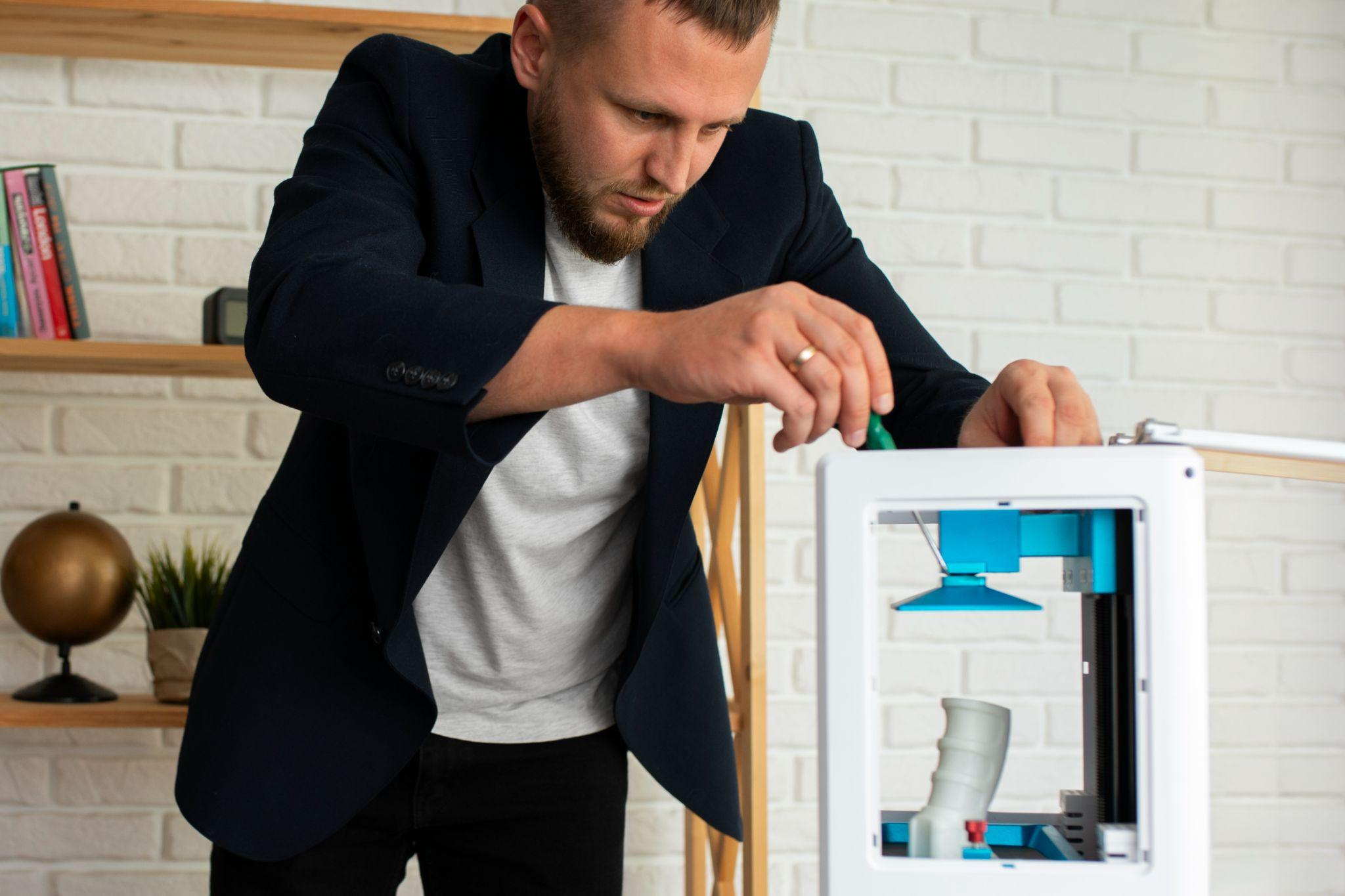
It’s frustrating when a small part breaks and renders an entire item useless. Often, we either discard it or spend money on a replacement, even if the issue is minor. But what if you could fix it within hours instead of replacing it? That’s where 3D printing comes in.
From missing knobs to cracked clips, people are now creating simple parts at home or locally to revive items. This change is making repairs faster, cheaper, and more accessible for everyone.
Digital Inventory and the On-Demand Repair Shift
Traditional repair supply chains face three main issues: they’re slow, expensive, and unreliable under pressure. Digital inventory changes this entirely. Instead of storing physical stock, you store files.
Parts Printed When You Need Them
The appeal of 3D printed replacement parts is that production occurs when demand arises, not months in advance. Philips recognized this early. Their “Fixables” program allows customers to download part files and print appliance components directly at home, reducing wait times to almost nothing. No backorder, no shipping delays—just a file and a printer. This approach often complements methods like custom plastic thermoforming, providing users with flexible ways to recreate and repair parts quickly.
Significant Reduction in Overhead
Heavy-duty truck repair operations are already benefiting from this. Instead of halting production lines while waiting for suppliers, technicians print brackets and custom fixtures in hours. The financial impact is significant; every hour a line keeps running is an hour you’re not losing money.
Storing digital files rather than physical parts reduces overhead and fundamentally changes the repair process. Once customization is involved, things become even more interesting.
The Real Power of Customization in Repairs
Generic replacement parts are convenient when they work. However, when they don’t fit quite right, you notice every millimeter of the mismatch. That’s where custom 3D printed repairs excel compared to standard shelf options.
Precision-Built for Specific Breaks
Services like 3D Print My Thing specialize in creating tailored replacements for components that off-the-shelf solutions can’t address. IKEA and Philips have gone further, developing complete DIY repair ecosystems with downloadable files for frequently damaged household parts. Consumers benefit directly from this.
Importance of Surface Quality
After a component is printed, combining additive manufacturing with custom plastic thermoforming can significantly improve surface quality and dimensional accuracy. This means the finished part doesn’t just fit; it performs and looks the part. This combination is important in both professional and consumer-facing applications.
Tailored repair is no longer niche. Entire industries are scaling it.
3D Printing Repairs Across Industries
A decade ago, discussing 3D printing repairs in heavy industry might have received a polite smile and not much else. Today, the adoption is genuinely striking.
Automotive and Heavy Equipment
OEMs, including Daimler and Volvo, now support printed parts for bus and truck maintenance programs. Companies like SSR are using Raise3D automation specifically for automotive plastic repairs, reducing turnaround from days to hours. This efficiency isn’t a novelty; it’s a competitive edge.
Infrastructure at Scale
One of the most compelling emerging applications involves metal 3D printing for aging infrastructure. Experimental techniques now spray metal powders directly onto structural surfaces for bridge repair. This ambitious approach is already being tested in the field.
The industries using 3D printing for repairs extend well beyond garages and workshops. But there’s another angle worth considering: what if printing the replacement part could make it stronger than the original?
Printing Better Than the Original Design
Reprinting a broken component doesn’t mean you have to recreate the same design that failed initially.
Redesigning Geometry for Durability
Experienced DIY makers often rebuild broken parts with reinforced geometry, thicker walls, smarter load distribution, and improved structural logic. The result frequently outperforms the original OEM specification in targeted stress scenarios. You’re not just fixing something; you’re improving it.
The Critical Material Decision
Entry-level printer adoption is growing at 28% year-over-year, reflecting real and expanding demand for accessible repair technology. The material you choose, whether rigid ABS for structural parts or flexible TPU for components that need flexibility, determines whether your fix lasts a week or years.
The Ecosystem Enabling Repairs for Everyone
Makerspaces, public libraries, and open-source platforms like Thingiverse and iFixit have democratized access to professional repair tools in ways that seemed implausible fifteen years ago.
The Value of Community Knowledge
If an obscure appliance part breaks, there’s a reasonable chance someone has already modeled a fix and shared the STL file publicly. That collective knowledge base is powerful. You’re not starting from scratch anymore.
Sustainability: Repair as an Intentional Choice
Environmentally, repair consistently beats replacement. Philips’ community fix programs and industrial operations avoid unnecessary procurement, reducing material waste in measurable ways. Choosing custom 3D printed repairs is increasingly an environmentally considered decision, not just a practical or financial one.
The Repair Revolution Is Here
3D printing repairs have transitioned from an engineering curiosity to a genuine operational necessity across industries and households. Digital inventories eliminate supply chain delays. Customization outperforms generic alternatives. Advanced materials push repair performance beyond original specifications. Growing community ecosystems mean you’re rarely solving the problem alone.
That broken item sitting on your shelf right now? There’s a meaningful chance a file already exists to fix it or could be built in an afternoon. The case for repair over replacement has never been more practical, affordable, or compelling than it is today.
FAQs on 3D Printing for Repairs
What’s the most impressive thing ever 3D printed?
The list is remarkable: mouse ovaries, robot skin, real human tissue, food, model fetuses, coral reefs, full-scale houses, and functional rocket engines. The creative possibilities seem endless.
How do 3D printed parts compare to OEM in terms of durability?
With the right material selection and intentional geometry improvements, printed parts often match or outperform original OEM components. High-strength composites combined with reinforced design frequently exceed original performance in targeted stress conditions.
What does a beginner need to start?
An entry-level FDM printer, free CAD tools like TinkerCAD, and access to Thingiverse’s file library will get you started. Most first repair projects require no specialized expertise, just some patience and a willingness to iterate.