Introduction
In the race to innovate within automotive mobility solutions, the bridge from concept to reality is built through rapid prototyping. Moving from design validation to functional testing swiftly is paramount. However, teams frequently encounter a critical bottleneck: prototyping iterations that are not only costly but also unpredictable. These expenses can drain precious R&D budgets and cause significant project delays.
This article deconstructs the core factors influencing CNC machining rapid prototyping costs, focusing on automotive component development. It provides a actionable framework for cost control. By implementing strategies like Design for Manufacturability (DFM) optimization and precise material-process matching, teams can effectively compare rapid CNC prototyping costs and achieve greater efficiency.
What Drives Your Rapid Prototyping Service Quote? A Cost Structure Analysis
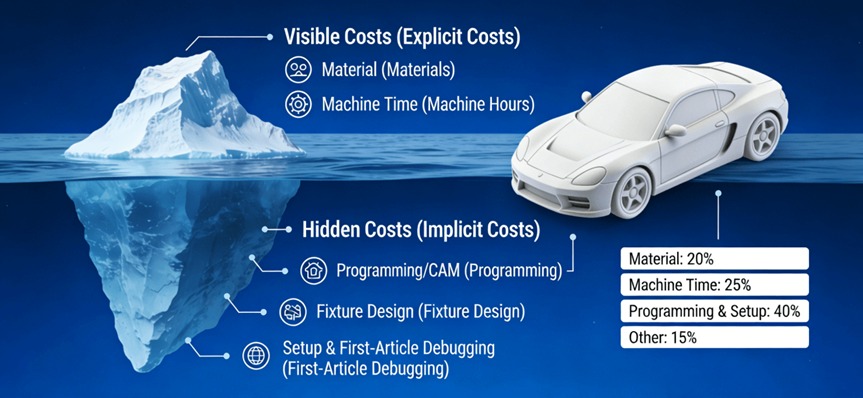
The quoted price for a prototyping and CNC machining project is merely the tip of the iceberg. Beneath the surface lie both visible and hidden cost drivers that collectively determine the final figure. Understanding this structure is the first step toward informed decision-making.Visible, or variable, costs are typically tied directly to the part: the raw precision custom manufacturing material (e.g., aluminum billet, engineering plastic) and the machine time (hours on a 3-axis or 5-axis mill). These are often the most straightforward components of a quote.
The true complexity—and cost—lies in the fixed and preparatory costs, especially for low volumes. A study by the American Manufacturing Institute highlights that in small-batch production, fixed costs can constitute a significant portion of the unit price. These “hidden” costs include programming & CAM setup, fixture & workholding design, and first-article debugging. Consider a prototype for an automotive sensor housing. The quote encompasses the engineer’s time to program complex internal channels, the design of a custom fixture, and the meticulous first-run adjustment to hit critical tolerances. This intricate dance of fixed and variable costs defines the economic reality of low-volume, high-mix manufacturing.
How to Slash Over 30% of Prototyping Costs at the Design Source?
A fundamental rule in manufacturing is that approximately 80% of a part’s final cost is determined at the design stage. Proactive CNC machining rapid prototyping cost choices are the most powerful lever for cost control. Implementing Design for Manufacturability (DFM) principles for CNC machining can yield dramatic savings without compromising function.
Core Principles for Design Efficiency
Three foundational design for manufacturability strategies are paramount. First, standardizing internal radii minimizes tool changes. Second, optimizing depth-to-width ratios avoids expensive, fragile specialty tools. Third, applying tolerances strategically—reserving tight specs only for critical features—reduces machining and inspection time.
Bridging Design Intent with Production Feasibility
Advanced design goals must align with machining realities. For example, topology-optimized, lightweight parts must also be manufacturable.
- The Cost of Complexity
A lightweight design requiring complex 5-axis machining for all features often costs more than a slightly heavier, 3-axis-friendly alternative, negating the intended benefit.
- The Value of Early Collaboration
This underscores the need for early manufacturing input. Expert feedback transforms theoretical design optimization into a cost-effective, producible component, ensuring performance and manufacturability are balanced from the start.
Material Selection: The Art of Balancing Performance and Budget
Choosing the right material is a critical decision that sits at the intersection of part performance, prototyping timeline, and budget. An “over-engineered” material choice is a common source of unnecessary rapid prototyping costs.
For automotive prototypes, the selection matrix typically includes Aluminum 6061 for its excellent balance of machinability, strength, and cost; Stainless Steel 316 for applications requiring corrosion resistance; and Engineering Plastics (like PEEK or Nylon) for unique benefits like electrical insulation and low weight. The guiding principle is “fit for purpose.” Can a CNC rapid prototyping run for a functional test of a mounting bracket use aluminum instead of titanium? For a prototype engine cover, could a glass-filled nylon simulate the properties of the final composite at a fraction of the cost? A disciplined approach to material selection ensures the budget is spent on validating design, not on excessive material properties.
CNC Machining vs. 3D Printing: Choosing the Most Cost-Effective Process for Prototyping
Selecting the right rapid prototype services technology is crucial for budget and timeline. CNC machining and 3D printing serve different needs in the prototyping continuum.CNC machining excels in material fidelity, precision, and strength, using isotropic engineering-grade materials ideal for functional testing. 3D printing offers superior geometric freedom and speed for highly complex, single-piece concept models.
A strategic approach is to use each technology where it shines. 3D printing is ideal for early-stage form-and-fit models. For functional prototypes that must withstand real-world stresses or thermal cycles, prototyping CNC machining is typically the necessary choice, as the parts behave like the final product, providing reliable test data.For validating automotive mobility solutions that involve powertrain, chassis, or safety-critical systems, CNC machining is often non-negotiable. The need for high precision, structural integrity, and real material properties makes it the gold standard. Understanding this distinction is key to allocating the prototyping budget effectively. For teams looking to dive deeper into managing these costs, a review of factors and solutions offered by expert rapid prototyping services can be invaluable.
Beyond Unit Price: Hidden Value Points When Evaluating a Prototyping Supplier
While unit price is a key metric, it is a narrow lens for evaluating a CNC machining rapid prototyping partner. The true cost includes time, risk, and rework. A slightly higher unit price from a superior vendor can result in a lower total project cost.
Technical Collaboration and Risk Mitigation
The most significant value often comes before the order is placed. A supplier that provides comprehensive, proactive DFM (Design for Manufacturability) analysis acts as an extension of your R&D team. This early engineering partnership identifies potential manufacturing issues, preventing costly redesigns and delays, thereby mitigating project risk from the outset.
Technical Capabilities and Strategic Partnership
Evaluating a supplier’s technical and operational backbone is critical for ensuring consistent quality and scalability.
- Certifications and Process Reliability
Assess foundational quality systems. A supplier holding stringent certifications like IATF 16949 (automotive) or AS9100D (aerospace) demonstrates a process-driven commitment to quality that surpasses basic standards. This systemic approach translates directly to higher part reliability and first-pass yield.
- End-to-End Partnership Value
Consider the supplier’s ability to scale with your project. A true partner offers seamless support from rapid prototyping services through full-scale production. This integrated, full-stack model, as exemplified by firms like JS Precision, ensures consistency and delivers superior long-term value.
Conclusion
Controlling rapid prototyping service quote is not about finding the cheapest bid; it is a systematic engineering discipline. It runs through every phase: intelligent design (DFM), informed material and process selection, and a strategic partnership with a qualified supplier. Automotive R&D teams that engage in proactive DFM collaboration and precise process planning transform cost control from a reactive exercise in negotiation into an active driver of value creation and accelerated innovation.
If a high-cost prototype for an automotive component is impacting the development timeline, the first proactive step is to obtain a professional, design-for-manufacturability analysis based on the 3D model. This crucial report will illuminate the cost drivers and optimization opportunities specific to the part.
Author Bio
This article was written by an industry observer with over a decade of experience in precision manufacturing, with a focus on the application and cost-benefit optimization of advanced manufacturing technologies in the automotive and mobility sectors.
FAQs
Q: How much does a simple aluminum automotive bracket prototype typically cost?
A: The price is driven by complexity, size, and precision. A fist-sized, structurally simple 6061 aluminum bracket with standard tolerances might cost between 150and400. Implementing DFM optimizations can typically save 20-30% on this cost.
Q: Why are CNC prototypes usually more expensive than 3D printed ones?
A: The main difference lies in fixed costs. CNC involves programming, fixture design/setup, and machine amortization, which are high and allot over a small number of parts. 3D printing pricing is largely based on material volume and print time, making it cost-effective for complex geometries in single quantities, though strength and precision are generally lower than CNC.
Q: How can I ensure my design files are kept confidential when requesting a quote?
A: Always choose a supplier with a strong information security policy. Reputable service providers will offer a Non-Disclosure Agreement (NDA), use encrypted file transfer systems, and strictly limit internal access to customer data to only personnel essential to the project.
Q: What should I be most wary of when reviewing a prototype quote?
A: Be wary of quotes that are overly simplistic and show only a bottom-line price. A professional quotation should transparently itemize estimates for material, machine time, programming, setup, post-processing, and any administrative fees. This breakdown is essential for understanding cost drivers and identifying areas for optimization.
Q: What is the re-quote process if the prototype design needs modification?
A: Typically, the revised 3D model would be provided. A professional supplier can assess the impact of the changes on the manufacturing process and hours within 1-2 business days, providing an updated quote and delivery timeline with clear communication on the cost delta.