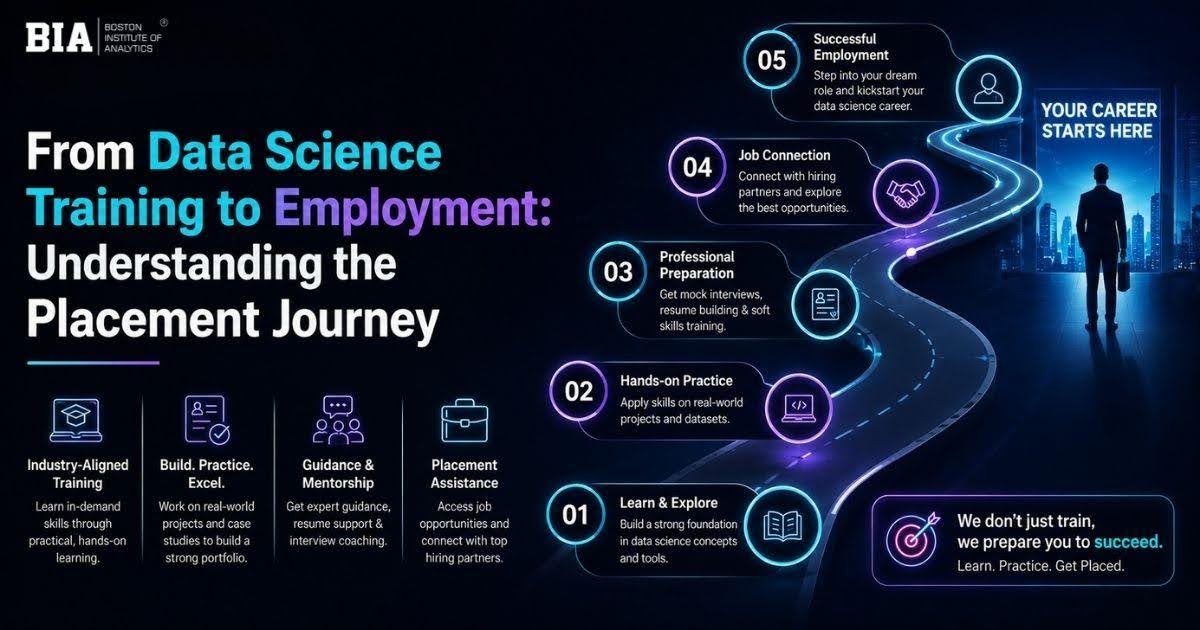
Data Science Training can enable candidates to be employable if it involves technical training, portfolio creation, interview preparation, and career guidance. Even though Data Science Certification might help prove course completion, the companies generally look for the capability of solving problems using data by the candidates.
The entire process is helpful for both new graduates, employed people, those who want to switch careers, as well as technical and non-technical students. The process generally includes five steps including learning basics, developing projects, creating employability proof, preparation of interviews, and finally making applications. The current paper provides information on each step and criteria for evaluating Data Science Program.
What does Data Science Training actually teach?
Data Science Training enables students to gather, process, analyze, create models for, visualize, and present their findings from the data. A well-rounded training program also enables the student to convert the technical information into business intelligence.
The strongest programs usually include:
- Python: Variables, functions, data structures, NumPy, pandas, exploratory analysis, and automation.
- SQL: Joins, aggregations, subqueries, window functions, and analytical queries.
- Statistics: Probability, distributions, sampling, hypothesis testing, correlation, and regression concepts.
- Data visualization: Charts, dashboards, storytelling, and tools such as Tableau or Power BI.
- Machine learning: Regression, classification, clustering, feature engineering, model evaluation, and overfitting.
- Advanced topics: Deep learning, natural language processing, computer vision, generative AI, or MLOps.
- Business communication: Problem framing, insight interpretation, presentations, and stakeholder communication.
A Data Science Training course in India should link these subjects together rather than treat them separately. For instance, a student should be able to utilize SQL to pull customer data, use Python to analyze churn behavior, utilize machine learning to predict risk, and then use a dashboard to present their finding.
This process is closer to the actual project workflow and can help the candidate give relevant examples during an interview.
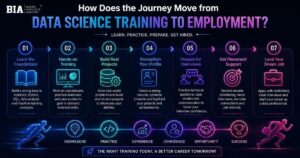
How does the journey move from data science training to employment?
From Data Science Training to becoming employed takes normally five steps, namely: foundation, application, proof, readiness, and market access. The candidates move faster in case there is an outcome from each step.
1. Build the technical foundation
Step one builds the foundation for working with data. The learner must be able to comfortably use Python, SQL, statistics, spreadsheets, and visualization.
It is not about learning all the libraries. It is about answering questions correctly and explaining the logic behind the answers.
A useful foundation milestone is the ability to:
- Import and inspect a dataset.
- Identify missing, duplicate, or inconsistent values.
- Write SQL queries to answer business questions.
- Select appropriate charts.
- Explain averages, distributions, and relationships.
- Build and evaluate a basic predictive model.
2. Apply skills through guided projects
Projects turn lessons learned into proof of skill. Any project must start with a specific business challenge, rather than an arbitrary dataset.
A strong project includes:
- Business objective.
- Data source and limitations.
- Cleaning and preparation decisions.
- Exploratory analysis.
- Modeling approach, if relevant.
- Evaluation metrics.
- Key findings.
- Recommended business action.
- Clear documentation.
For instance, a retail project can explore reasons for a decline in repeat sales. The candidate can segment customers, discover customer behaviour, develop a churn prediction model, and recommend retention strategies.
A project will become even more valuable if the candidate discusses compromises. A less accurate model can be preferred if it is simpler to explain and implement.
3. Create job-ready evidence
The portfolio, résumé, GitHub repo, LinkedIn, and project presentation should tell the same professional story. An employer must be able to easily figure out what the candidate is capable of doing and what positions he/she is aiming for.
Project descriptions should not contain vague phrases like “did data analysis.” Here’s how one could describe their work:
“Conducted data analysis on transactions using SQL and Python; identified high-risk customers and designed retention strategies based on purchase frequency and regency.”
It is expected of candidates to include screenshots, notebooks, dashboards, code explanations, instructions for their GitHub, and a brief project description.
4. Prepare for assessments and interviews
Data science hiring normally tests several abilities rather than one theme. Preparation should cover technical, analytical, communication, and behavioural questions.
Candidates should practise:
- SQL query writing.
- Python data manipulation.
- Statistics and probability.
- Machine learning concepts.
- Case-study problem solving.
- Dashboard or chart interpretation.
- Project walkthroughs.
- Résumé-based questions.
- Communication with non-technical stakeholders.
Interview preparation is most successful if there is logic in the form of response: identifying the problem, assumptions, methodology, limitations, and solution.
5. Enter the job market strategically
Submitting applications for all positions with the designation of “Data Scientist” usually gives poor results. New graduates may look for better possibilities in similar jobs including data analyst, business analyst, product analyst, reporting analyst, junior machine learning engineer, or analytics consultant.
Job targeting should consider:
- Current technical skills.
- Previous industry experience.
- Location and work model.
- Required years of experience.
- Domain familiarity.
- Portfolio relevance.
- Growth potential.
The software developer can try applying for positions of machine learning engineer or analytics engineer. The person from finance can try risk analytics or financial data analysis. The graduate of business can start with business intelligence or product analytics.
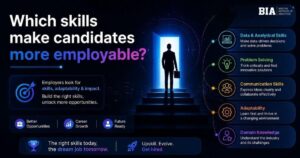
Which skills make candidates more employable?
By integrating technical skills and the ability to interpret and communicate in business terms, candidates make themselves more appealing for employment. Employers are looking for someone who can go from an ambiguous problem in business to a reasonable recommendation.
Skill area
Evidence employers may look for
Example output
SQL
Ability to query and validate data
Customer retention analysis
Python
Reproducible analysis and automation
Data-cleaning notebook
Statistics
Correct interpretation of uncertainty
A/B test recommendation
Machine learning
Appropriate model selection and evaluation
Churn prediction model
Visualization
Clear communication of findings
Executive dashboard
Business thinking
Understanding of impact and trade-offs
Pricing or marketing recommendation
Communication
Ability to explain technical work simply
Five-minute project presentation
Collaboration
Documented, organised work
GitHub repository and project notes
It is essential for candidates to recognize when correlation should be separated from causation. Moreover, candidates must know that a good score of the model does not necessarily mean that there is business value.
For example, a fraud model could be highly accurate in identifying fraud but would produce a lot of false positives. A candidate with knowledge about the costs involved in this case is more insightful than one who only knows about accuracy.
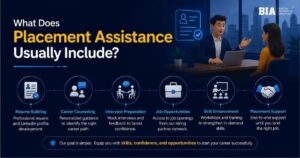
What does placement assistance usually include?
Career guidance normally encompasses career counselling, résumé building, interview training, connections to employers, and application assistance. The process must enhance the learner’s access and preparedness without presenting itself as an automatic employment guarantee.
Potential services include:
- Career-path assessment.
- Role and industry mapping.
- Résumé and LinkedIn reviews.
- Portfolio feedback.
- Mock technical interviews.
- Case-study practice.
- Communication coaching.
- Job alerts and application support.
- Placement drives or employer introductions.
- Guidance on offer evaluation and negotiation.
The level of assistance will be determined by the extent of the institute’s involvement with the learners. An open job portal does not amount to career counselling.
Before enrolling, ask:
- What does “placement assistance” specifically include?
- Are learners eligible for support only after completing assessments?
- How are job opportunities matched to learner profiles?
- Are placement statistics defined clearly?
- Are outcomes separated by role, experience level, and location?
- Can the institute share verifiable alumni profiles?
- Does career support continue after the course ends?
An authentic Data Science Institute will make its process clear. It will be able to differentiate interviews that have been set up, employment offers, and those that have been taken up.
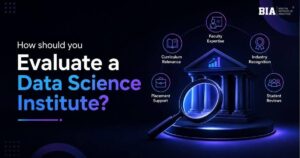
How should you evaluate a Data Science Institute?
However, the most suitable Data Science Institute may not be the one offering the most extensive syllabus or the most promising salary prospects. It is important for the potential learners to consider some practical factors when making their decision.
Evaluation factor
What to check
Warning sign
Curriculum
Python, SQL, statistics, ML, visualization, projects
Tool list without application
Faculty
Industry experience and teaching clarity
No instructor profiles
Projects
Reviews, feedback, business context
Only copied tutorial projects
Mentoring
Mentor access and response process
Support limited to recorded videos
Assessments
Tests, code reviews, presentations
Certificate based only on attendance
Career support
Résumé, interviews, applications, employer access
Vague “100% placement” language
Transparency
Eligibility, outcomes, fees, refund terms
Unverifiable claims
Flexibility
Online, classroom, weekend, or hybrid options
Schedule unsuitable for working learners
Location
Mumbai, Bengaluru, Pune, Hyderabad, Chennai, Delhi, or remote delivery
No clarity on delivery format
Alumni outcomes
Role, employer, date, and learner background
Anonymous testimonials only
Boston Institute of Analytics must look at the presentation of its Data Science Program from this perspective. Potential learners must go through the syllabus, project methodology, mentoring strategy, career development process, learning methods, and terms of service before making a choice.
Can beginners and career switchers enter data science?
There is room for beginners and career changers in data jobs, but they require a staged learning process and realistic job targets. The non-technical graduate does not have to be a machine learning researcher before being able to find a job as an analyst.
Data science training for beginners in India
Beginners should start with:
- Spreadsheet-based analysis.
- Basic mathematics and statistics.
- Python fundamentals.
- SQL querying.
- Data visualization.
- Exploratory data analysis.
- Introductory machine learning.
- Portfolio and interview preparation.
The initial target for a beginner could be the position of a data analyst or business intelligence specialist. As the technical skills are improved, the learner can move on to more difficult jobs of data scientist or machine learning engineer.
Working professionals
Domain knowledge can be an asset for working professionals. A person in marketing can specialize in customer analysis. An operations specialist can study forecasting and process optimization. A specialist in IT can concentrate on data engineering, cloud analytics, or MLOps.
Career changes will sound more believable if the candidate explains why his/her past experience is relevant for the new profession. The résumé should demonstrate transferable skills instead of hiding the past job.

What should learners do after completing training?
The learners should be guided to follow an employment program for 90 days following the completion of Data Science Training. The program should incorporate the improvement of the portfolio, application to relevant firms, practicing interviews, and weekly measurable activities.
Days 1–30: Build evidence
- Finalise two or three strong projects.
- Publish clean documentation.
- Rewrite the résumé for one target role.
- Update LinkedIn and GitHub.
- Prepare concise project explanations.
- Complete a skills-gap assessment.
Days 31–60: Increase market activity
- Apply to carefully matched roles.
- Contact alumni and relevant professionals.
- Attend institute or industry networking events.
- Practise SQL, Python, and case studies.
- Request feedback after interviews.
- Adapt the résumé to recurring job requirements.
Days 61–90: Improve conversion
- Track applications, responses, interviews, and rejections.
- Identify the stage with the greatest drop-off.
- Improve the specific weakness.
- Add one relevant project feature or technical skill.
- Conduct weekly mock interviews.
- Expand applications to adjacent analytics roles.
A simple chart can help determine where the problem is; whether it is visibility, resume adequacy, assessment performance, or interview communication skills.
FAQ: Data Science Training and placement
Is Data Science Certification enough to get a job?
Just Data Science Certification alone might be insufficient in gaining employment. There is also an evaluation of practical projects, technical assessments, communications skills, problem solving skills, and experience.
Does every Data Science Course in India provide placement?
No, not all the courses have equal placement services. Learners must be aware about what they are getting from the placement services whether mentoring, interview prep, introductions to employers, application assistance, or only listing of jobs.
What is the best data science training in India?
The right training will depend on the quality of curriculum, mentor, project evaluations, form of delivery, career services, transparency, and the intentions of learners. Compare the quantifiable aspects of the programs and not just rankings and salaries.
Can a non-technical graduate learn data science?
Yes, even a non-technical graduate can master the skill of Data Science following a step-by-step process. The learner must start with spreadsheets, statistics, Python, SQL, and visualization before moving to machine learning.
How long does it take to become job-ready?
Some learners need months of consistent study and practice before they are eligible to apply. The time frame may vary based on previous education, weekly study hours, and programming experience.
What is the best data training course with placement?
The perfect program should include practical education and career support with clear and concrete criteria. Analyze project evaluation, availability of mentoring, preparation for an interview, employment of companies, and results verifiable by the learners.
Are data science jobs available outside Bengaluru and Mumbai?
Yes, positions in the field of data and analytics are available in Pune, Hyderabad, Chennai, Delhi, Thane, and other Indian cities. Even remote or hybrid positions can be considered for broadening the scope of search, but each employer has its own requirements.
Can an institute guarantee a data science job?
A responsible educational institution should not promise employment to all learners. Employment depends on skills, quality of the portfolio, experience, performance in an interview, job market situation, and efforts put by the candidate.
Final Thoughts
Data Science Training in India is useful for you when it pushes you past certifications and prepares you for solving real-life business issues. The path from understanding Python, SQL, statistics, and machine learning concepts to getting hired involves lots of practice, good portfolio projects, interviews, and career planning.
Data Science Certification will make your profile impressive, but practical proof will still matter. Potential employers need to see how you work with data cleaning, analysis, modelling, interpretation, and business decision-making. Developing and presenting three to five suitable projects can be a good way to prove all that to employers.
Getting career assistance will make the whole process more organized with help of resume reviews, mock interviews, career advice, networking, and contacts with employers. Nonetheless, successful job placement is dependent on your efforts, skills, interview, choice of role, and consistent application.