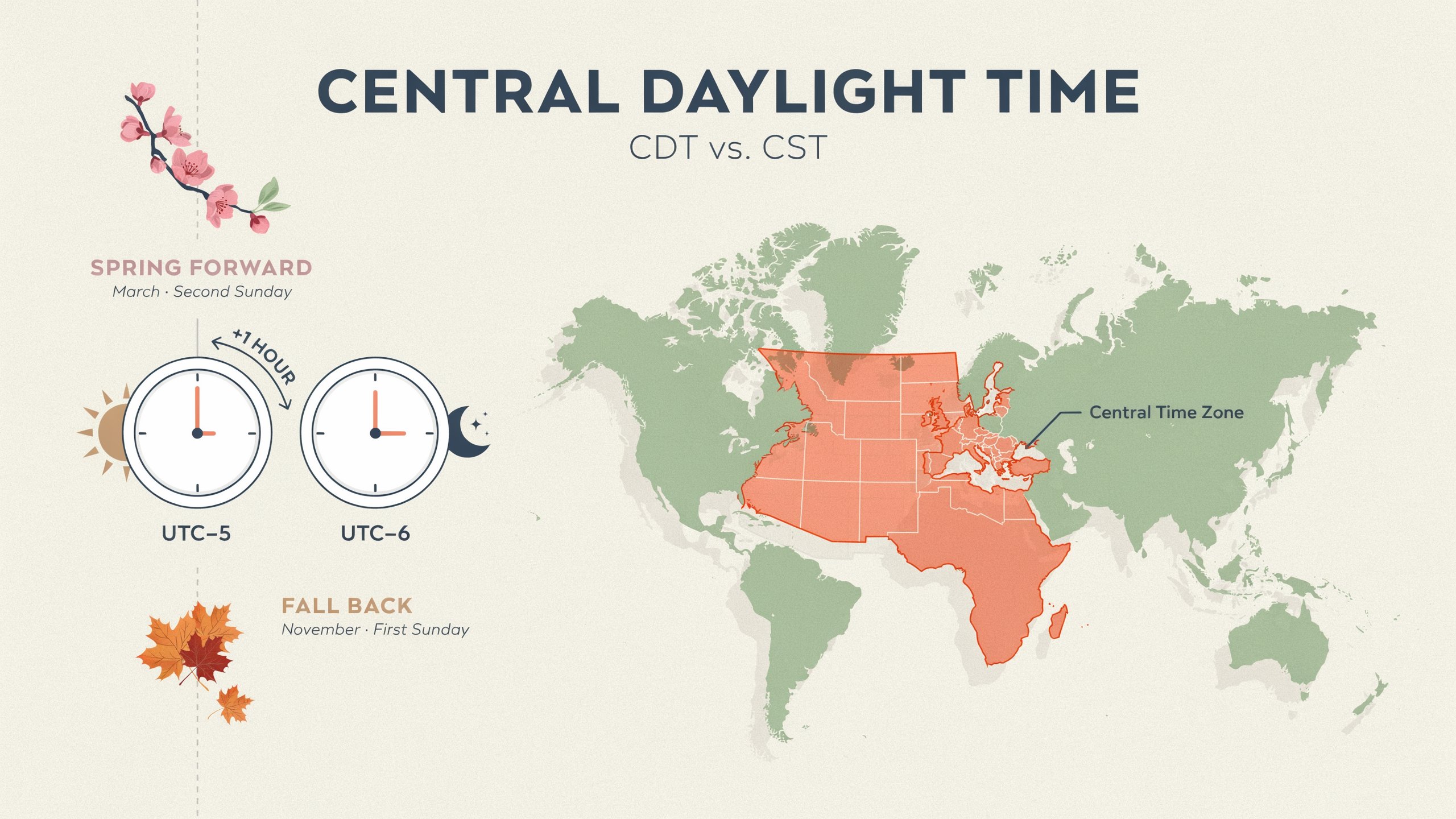
Understanding how time works across different regions can feel confusing, especially when you come across terms like CDT. Many people search for CDT time now when trying to figure out the correct local time in parts of North America. The reason for this confusion is that CDT does not stay the same throughout the year. It changes depending on the season due to daylight saving practices.
This article explains what CDT is, how it works, why it changes, and how it affects daily life, schedules, and global communication in a simple and clear way.
What is CDT Time
CDT stands for Central Daylight Time. It is a time zone used in the central region of North America during the daylight saving period. CDT is typically active in countries like the United States, Canada, and parts of Mexico.
The main idea behind CDT is to make better use of daylight during the longer days of the year. Instead of keeping the clock fixed all year, the time is adjusted forward during warmer months so that evenings have more daylight.
In simple terms, CDT is the “summer version” of Central Time.
Understanding CDT Time Now
When people search for CDT time now, they are usually trying to find the current local time in regions that follow Central Daylight Time.
CDT is always:
- 5 hours behind Coordinated Universal Time (UTC−5)
- One hour ahead of Central Standard Time (CST)
However, the important thing to understand is that CDT is not active all year. It only applies during a specific part of the year when daylight saving time is in effect.
During other months, the same regions switch back to CST, which is UTC−6.
This shift is the reason why checking CDT time now is important instead of assuming the same time zone throughout the year.
Why CDT Changes During the Year
The biggest reason CDT changes is due to daylight saving time. This system was created to better align human activity with natural daylight.
The Idea Behind Daylight Saving
The basic concept is simple. During summer months, the sun rises earlier and sets later. To make better use of evening daylight, clocks are moved forward by one hour.
This means:
- Morning light becomes slightly shorter
- Evening light lasts longer
This shift helps people enjoy more daylight after work or school hours.
When CDT Starts and Ends
CDT does not stay active permanently. It follows a fixed seasonal schedule.
Start of CDT
CDT begins in spring when clocks are moved forward by one hour. This transition marks the beginning of daylight saving time.
End of CDT
In autumn, clocks are moved back by one hour. At this point, CDT ends and CST (Central Standard Time) begins again.
This cycle repeats every year, which is why the time in the same region can change twice annually.
Difference Between CDT and CST
Many people confuse CDT with CST, but they are not the same.
CDT (Central Daylight Time)
- Used during daylight saving months
- UTC−5
- More evening daylight
CST (Central Standard Time)
- Used during non-daylight saving months
- UTC−6
- Standard time without adjustment
The one-hour difference between them is what often causes confusion when checking CDT time now online or in schedules.
Which Regions Follow CDT
CDT is mainly used in the central part of North America. This includes major cities and regions such as:
- Central United States
- Parts of Canada
- Certain areas of Mexico
However, not all places in these regions follow daylight saving time in the same way. Some locations may choose to remain on standard time throughout the year, which adds another layer of complexity.
Why CDT Time Matters in Daily Life
Time zones are not just technical systems. They directly affect everyday life.
Work and Business
Many companies operate across multiple time zones. Knowing CDT time now is important for scheduling meetings, especially for remote teams working internationally.
Travel and Flights
Flight schedules often use local time zones. A small misunderstanding in CDT can lead to missed flights or confusion about arrival times.
Online Communication
From webinars to virtual meetings, global communication depends on accurate time coordination. CDT plays a major role in North American scheduling.
How CDT Affects Digital Schedules
Modern technology has made time tracking easier, but CDT still creates challenges when systems switch between daylight saving and standard time.
Many apps and devices automatically adjust, but errors can still occur if:
- The device settings are incorrect
- The location is not updated properly
- Time zones are manually changed
This is why people often double-check CDT time now before important calls or events.
Common Confusion About CDT
One of the most common mistakes is assuming CDT is a permanent time zone. In reality, it is temporary.
Another confusion happens when comparing international time zones. For example, someone in Asia or Europe may find it difficult to calculate the exact difference without knowing whether CDT or CST is currently active.
This is why it is always important to confirm whether daylight saving time is in effect.
The Future of CDT and Daylight Saving
In recent years, there has been ongoing discussion in many regions about whether daylight saving time should continue. Some argue that the time changes create unnecessary confusion and disrupt sleep patterns, while others believe it helps save energy and improves evening productivity.
However, as of now, CDT continues to be used every year in regions that follow daylight saving rules.
Final Thoughts
CDT is more than just a time zone. It is part of a seasonal system designed to make better use of daylight throughout the year. Understanding how it works helps avoid confusion, especially when checking CDT time now for meetings, travel, or online events.
The key takeaway is simple: CDT is temporary, it changes with the seasons, and it always shifts between UTC−5 and UTC−6 depending on the time of year.
By understanding this pattern, it becomes much easier to stay accurate with time and avoid scheduling mistakes in a globally connected world.