
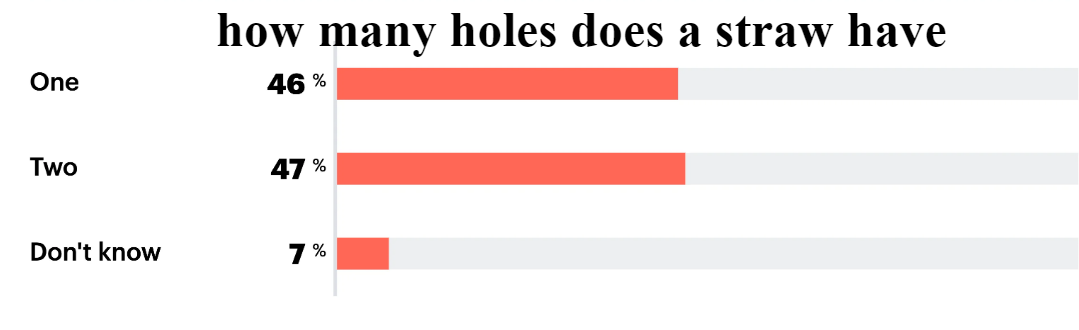
The question how many holes does a straw have has become a popular topic of curiosity, debate, and even scientific reasoning. While it may seem like a simple everyday object, a straw sparks discussions in geometry, topology, and design. Many people view it differently based on their understanding of shape, form, and structure. This article explores the concept in detail, breaking down the reasoning behind the answer and offering useful insights supported by topological concepts, geometric principles, and structural analysis.
The Science Behind the Straw
To understand the answer, you must consider how scientists view holes. In the field of topology, a hole is defined as a continuous path running through an object. Using this perspective, a straw is essentially a long cylinder with an open path from one end to the other. This makes it unique when compared to objects with multiple openings, surface punctures, or separate voids.
Topological Explanation
According to topology, a straw has one continuous tunnel. This tunnel simply has two ends but remains one single pathway. This reasoning is similar to how a tunnel in a mountain works: although it has two openings, it is still considered one hole.
Also, explore LeaveWeb: A Complete Guide To Understanding The Digital Leave Management Platform
Geometric Perspective
From a geometric viewpoint, a straw’s structure is a long hollow tube. Its interior is a complete cavity that stretches from top to bottom. While two openings exist, the space inside is unified, meaning it is not split into different compartments. The three-dimensional structure, cylindrical design, and hollow core all support the idea of a single continuous hole.
Common Misconceptions About how many holes does a straw have
Many people mistakenly think that a straw has two holes. This confusion comes from mixing up “holes” with “openings.” The two ends of the straw are actually openings, not separate holes. Just like a donut has one hole through its center, a straw is simply a stretched-out version of the same idea.
Two Openings but One Hole
People often count each end as a separate hole because each side looks like an individual opening. However, regardless of how many openings there are, the interior pathway stays connected. Therefore, even though you can look through from one end to the other, it still remains one hole.
Confusion with Multi-Hole Objects
Objects like salt shakers or colanders have multiple holes because each perforation is its own independent passage. A straw does not share this property. Its internal structure is one single, enclosed space, which aligns with the concept of a single continuous cavity.
Real-World Applications of This Concept
Understanding how many holes a straw has is not only academically interesting but also relevant in engineering, product design, and manufacturing. Designers who create cylindrical products use this concept to determine material strength, flow efficiency, and structural durability. For example, pipelines, drinking straws, and hollow tubes all follow similar design logic.
Importance in Education
Teachers often use this question to explain topology, critical thinking, and geometry. It encourages students to think beyond surface appearance and explore deeper reasoning. This is one reason the straw debate frequently appears in logical reasoning exercises and STEM discussions.
Final Answer
Based on scientific reasoning, the correct answer is that a straw has one hole. The continuous passage through the straw makes it a single hole with two openings.
Frequently Asked Questions
1.Does a straw have one hole or two?
A straw has one hole that runs through its entire length, even though it has two openings.
2.Why is it considered one hole?
Because the inside is one continuous tunnel, similar to a long cylindrical pathway.
3.Do the two ends count as separate holes?
No, they are openings, not individual holes.
4.What field of science explains this answer?
Topology, a branch of mathematics, explains the reasoning behind continuous surfaces and holes.
5.Is the straw debate used in education?
Yes, it’s often used to teach logic, critical reasoning, and spatial understanding.
Conclusion
In conclusion, the answer to how many holes does a straw have is one. Through the lens of topology and geometry, the straw’s structure forms a single continuous cavity rather than separate holes. This topic not only enhances understanding of everyday objects but also strengthens reasoning skills, making it a valuable example in both academic and practical discussions.

